Guitar Scale Length - Foreword
| This may be one of the best technical articles on
this website. I have been struggling with these concepts for
25 years. My hat is off to John Johnson for putting an
article together that clearly illustrates some of the things
I have been largely unsuccessful in clarifying in an article myself.
Hopefully John will contribute more articles. Ed Roman |
Guest Article by John Johnson
Electrical Engineer, Physicist & All Around Brainiac
Electric Guitar Pickup Location &
Choosing the Correct Scale
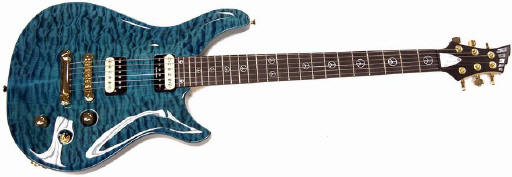
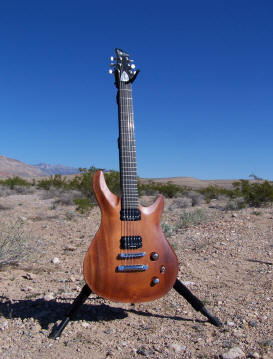
Quicksilver Guitars The Most Versatile Guitar On The Planet
|
Are you passionate about guitar tone?
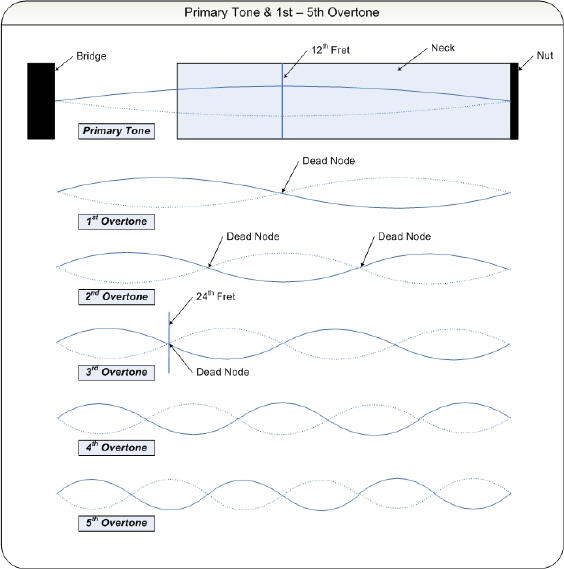
Many aspects of a guitar are subjective and we can argue about them until the Lord returns. They are a matter of personal preference - no right or wrong. What we are focused on here is based on the laws of physics. These are facts and if you make a decision without facts, you only have an opinion! Let’s briefly talk about the scale of an electric guitar. For the purpose of this article series I will focus on the 25” scale length. This is the length of the string between the nut and the bridge. Most electric guitars have a scale length between 24 ¾” and 25 ½”, with a few exceptions. The shorter the scale the shorter the spacing is between frets. And for any given gauge (thickness) of string the tension required to produce a given note is less than the same string on a longer scale. So for a given string gauge, a guitar with a longer scale will have more string tension along the neck. We’ll get into what all that means in another article. Pickup location is important because the amount of motion
(or distance travelled across the pickup) of a plucked string is different
as you travel along the string from one end to the other. The amount of
string vibration at the pickup location makes a difference in which notes
are picked up. Notice I said notes. When you pluck a string there is a
fundamental harmonic or PRIMARY TONE and a
series of OVERTONES. How much of the primary
tone and each successive overtone is picked up changes as you move the
pickup location up and down the strings. Following is an illustration to
demonstrate the vibration of a plucked string. Note the points along the
string where the string does not have any motion for a given overtone are
called NODES. Also think of the nut and bridge
as nodes. The greatest string travel for any given frequency that would
generate the most electrical energy or sound occurs at the center point
between the nodes of any given frequency.
|
 My desire is to educate you regarding the facts that
contribute to guitar tone in a series of articles. In this article I will
focus on pickup location. Pickup location is critical because for any pickup
to take the motion of a plucked string and turn it into sound it must be
placed near the strings - strategically.
My desire is to educate you regarding the facts that
contribute to guitar tone in a series of articles. In this article I will
focus on pickup location. Pickup location is critical because for any pickup
to take the motion of a plucked string and turn it into sound it must be
placed near the strings - strategically. |
Note from Ed Roman To Show Relevancy The interesting thing is that the fret locations get farther apart at an increasing or logarithmic rate as you move from the bridge toward the nut. However nodes occur at integer divisions of the scale. The illustration shows where the nodes are located when notes are played open. The nodes progress toward the bridge as you play notes down the fret board. So if you played with a capo over the 12th fret, all of the nodes move 50% toward the bridge. The 12th fret is 12 ½ inches from the nut or halfway between the nut and bridge, which is also the dead node location of the first overtone. One of my personal pet peeves is that many 22 fret guitars have a neck pickup right where The 24th fret would be, which happens to be a dead node of the 3rd overtone! Just one reason I am a proponent of a 24 fret guitar. |
|
Pickup positioning clearly effects the tone of your guitar and now you know why. It determines how much of the primary and each successive overtone is picked up. I hope the illustration helps you understand why the bridge and neck pickups sound so different. In particular, how critical the location of the neck pickup is and how it effects the sound created. I’ve calculated the dead nodes for every primary tone and each of the associated first five overtones possible on an electric guitar with a 25” scale and 24 frets. Ed Roman is in the process of building a custom Quicksilver for my son we’re calling the Quicksilver Wizard. I traveled to Ed’s custom shop to share my data with him and see how the stock Quicksilver pickup positioning compared. Ed was amazed as he told me how he had spent days with Seymour Duncan & Rick Turner positioning the neck pickup by ear. Guess what… the data backed up their ears. We measured the distance from the edge of the nut to the center of the poles on the neck pickup. It was exactly in the optimal location to maximize the overtones picked up, precisely 19.385” from the nut. The proximity of the pickup to a string also impacts the amount of electrical energy or sound created. It seems rather obvious, but if you raise or lower one end of the pickup you can add to or take away from the energy created by the strings nearest that end of the pickup. So if you want more bass, raise the top end of the pickup, lower the bottom end of the pickup or do a little of both. You may not be able to change your pickup location, but this is something I would encourage you to experiment with in your quest for just the right tone. In my next article I will focus on the guitar scale and
string gauge and give you the facts that contribute to the sound of your
guitar created by these factors. |
|
ADDENDUM
This article is very eloquently executed.
John has stated, in relatively simple terms, exactly why Ed Roman is a
proponent & strong supporter of the double octave guitar. (24 frets). NOTE
The Classic Fender Strat & Pearlcaster style guitars are
exceptions. Simply because our ears have grown accustomed to the nasal
ducktone & quack associated with that style of an instrument. Still
the fact remains they are improperly designed. The laws of physics are absolute.
This may sound sacrilegious, but Leo Fender for all of his genius was not a guitar player. His genius was that he built a guitar that played like butter and did it cheaply and extremely profitably. |
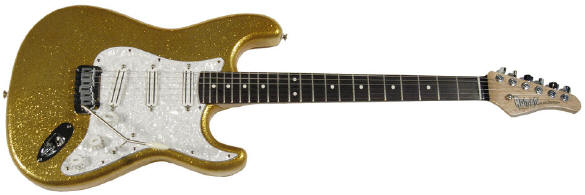
Ed Roman Pearlcaster only 22 frets
Soon To Be Available As A 24 Fret Quicksilver Guitar With No Neck Heel Same Body
Shape !!!!!