Composite Guitars and Graphite Guitars
Pros and Cons: Composites Versus Real Wood
Pssst: This Article is Pro Composite.
The purpose of this article is to educate the reader on composites, and why they are a compelling alternative to wood. Composites work very well with wood, or can replace wood if needed.
The word “composite” means two or more materials combined to form a composite material. Fiber reinforced materials, commonly referred to as composites, have been around for centuries. Early settlers found that by combining straw with mud, the composite was much stronger. Highways & bridges are composite because of the steel rebar embedded in the concrete. In today’s modern age, light weight composites in the form of fiber reinforced resins have become the standard in sporting goods and aerospace applications.
Modern composite materials use high strength fibers made from a variety of materials such as fiberglass, carbon, aramid, boron, and others. The most popular is carbon fiber, due to its high stiffness, high strength, and light weight. Carbon fibers may be manufactured from polyacrylonitrile (PAN), pitch, or rayon precursor materials by high-temperature (2000 to 35000 F) carbonization or graphitization processes, hence the name “graphite.”
Carbon fiber is useless without a resin binder. Typically, carbon fibers are coated with an epoxy resin which surrounds the fibers and holds them in place. This material is known as a pre-preg, which stands for “pre-impregnated” meaning the fibers have been embedded into the epoxy resin.
With pre-preg materials, the carbon fibers are unidirectional, meaning all the fibers run in the same direction parallel to each other. This is the most efficient arrangement of fibers. Fiber-Sonic, takes the pre-preg sheets and cut them to different shapes and at different fiber angles to create a “lay-up” specific to each individual product. For example, they can change the stiffness of a neck by simply changing the fiber angle. We can also combine different fibers to create a hybrid composite, which has beneficial properties of both. In addition, once the recipe is optimized the composite structure is repeatable part after part, ensuring consistent high quality time after time.
 This is what an ideal composite structure looks like up close, magnified 500X.
The fibers should be distributed in the resin matrix uniformly.
This allows the matrix material to transfer the load to the fibers in a uniform manner, resulting in an efficient structure.
|
Wood has a fiber structure very similar to a composite material. Wood is comprised of a fibrous structure of cellulose, which has a grain to it where the wood is stronger in one direction than another. This is because the cellulose fibers are parallel to each other, much in the same way unidirectional composites are formed.
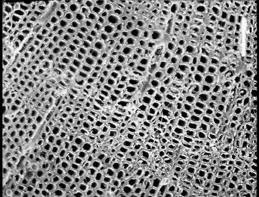 Wood comes in a
variety of species, all which have
different grain structures, densities, strengths, and
beauty. Even the same species of wood varies based on
growing conditions. Furthermore, within the same
tree, the properties of wood can vary. Despite these
inconsistencies, wood is an excellent material for
musical instruments, but has limitations:
Wood comes in a
variety of species, all which have
different grain structures, densities, strengths, and
beauty. Even the same species of wood varies based on
growing conditions. Furthermore, within the same
tree, the properties of wood can vary. Despite these
inconsistencies, wood is an excellent material for
musical instruments, but has limitations:
Wood is a natural material, meaning that variance can occur from batch to batch. Trees grow at different rates depending on weather, so every batch can be different.
Wood is affected by moisture, so factories must treat the wood & store in temperature & moisture controlled environments while manufacturing the product. Once the product is shipped, it remains susceptible to these environmental conditions, which can cause the wood to warp, crack, and change dimension.
Wood can expand and contract with temperature & moisture, effecting the production of wood parts, and affecting the sound of musical instruments. It is easy to see why wood instruments require constant tuning.
The fiber orientation of wood is limited to what nature gives us. It is possible to create a laminate of different plies of wood at different grain orientations (e.g. plywood) but the above deficiencies still exist.
Fiber Sonic, can design in the exact tone desired by changing the stiffness and weight of the component. Sound travels through a structure as a function of stiffness and weight, so it is possible to “dial in” the optimal combination for every application. With fiber reinforced composites, there are numerous ways to adjust the tone of the product:
Type of Fiber Used:
You can use very stiff and light carbon fibers, or heavier and more flexible glass fibers, or a combination of each to optimize the performance and cost.
Orientation of Fiber Angles:
A low angle like 0 degrees maximizes stiffness, where an intermediate angle such as 45 degrees is much more flexible.
Stacking Sequence:
different plies are stacked up creating the layup, the sequence and location of each fiber type can affect the stiffness and tone.
Different Resin Systems:
We can use a strong resin such as epoxy, which will produce good attack and sustain, or use a softer resin like a thermoplastic, which will produce a warmer tone.
The world of
composites offers unlimited options to optimize the
performance of a musical instrument. They can be used
alone or in combination with wood, to take advantage
of the best parts of both.
See LSR Guitars,
Beautiful Wood Bodies, with Composite Necks
See
Rainsong Guitars
The Best Acoustic Guitars Made From
Actual Graphite