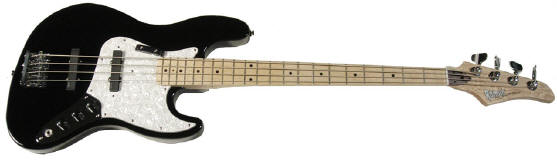
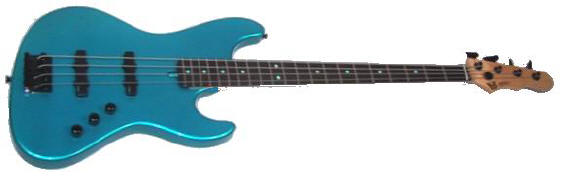
Lowrider Bass Guitars
Some History On Ed Roman's Lowrider Bass Guitars
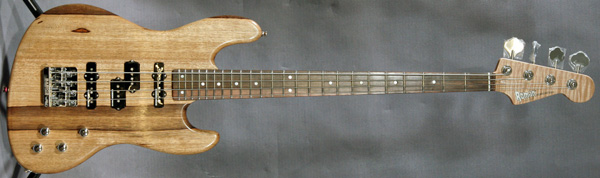
Custom Built Black Korina Pearlcaster Lowrider Bass
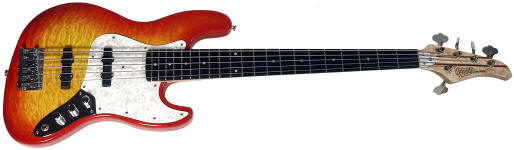

Ed Roman first started building bass guitars back in the early 80's with his partner & first luthiery teacher, Barry Lipman back in Connecticut at East Coast Music Mall. The original Basses were named R&L Basses. They were nationally advertised and met with a fair measure of success. The local musicians adopted the name "Rolip" which was short for Roman & Lipman.
Ed designed all the basses and decided on what woods, pickups & components to use. Barry executed the building & painting.
After several years it became apparent that Barry could no longer meet the demand for the basses. Ed sold his controlling interest in the companies East Coast Music Mall & Roman & Lipman and set out to build guitars with a new partner. Ed's new partner was a guitar bass building guru named Ron Blake.
Ron had been chief luthier for Carl Thompson for 21 years & had been responsible for prototyping the very first Ken Smith Bass. Ron also personally collaborated with Les Claypool on the original Scroll Bass and built about 6 of them for Les. He also built several hundred others for Carl Thompson who was selling them quite succesfully. Ron was also involved in Ghost building guitars & basses for many famous people including Stanley Clarke's famous Piccolo Bass. Ron never got the credit he deserved but that's what Ghost building is all about!!!.
Stanley Clarke has been credited with creating the piccolo bass (essentially a bass tuned one octave higher), and although he mainly plays Alembics, the first piccolo was a Carl Thompson. Stanley owns two Carl Thompsons, both piccolos. One is a 34" scale (the first piccolo ever), and the second is a 32" scale. When the first bass was being made, Stanley was so excited, he told Carl to bring it over the minute it was completed. Carl Thompson ended up hand delivering to Stanley at 3:00 in the morning! The second bass has a more interesting story. Stanley had just accidentally broken the headstock on his CT, and it could not be fixed before his next recording session. Carl was working on a 32" scale short bass at the time, and offered to lend it to Stanley. He modified the nut, finished it up quickly and gave it to Stanley. The Funk god liked it so much, he decided to buy it and use it as his backup bass. To this day, Stanley Clarke still uses that bass for dubbing and recording.
Luthier Carl Thompson built the first piccolo bass to Stanley´s specifications. It basically has the same intervals (E, A, D, G), scale and spacing of the regular bass, but it is tuned one octave higher. Other players have followed suit including Ron Carter who had an acoustic version built for him. But Stanley maintains: 'It was my idea.'
|
NOTE FROM ED |
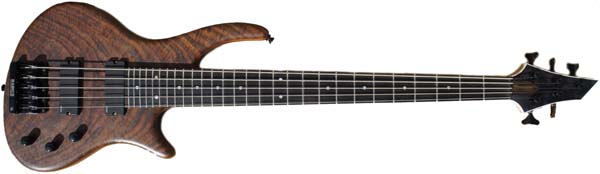
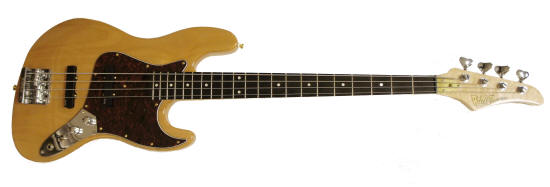
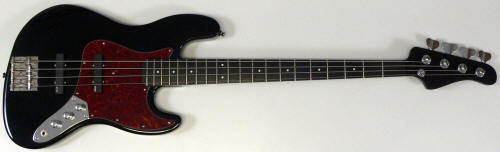
| In 1993 Ed started acquiring the inventory,
fixtures and tooling for several more defunct companies. BC Rich, Kramer &
Steinberger. Ed decided to concentrate on building instruments. It wasn't
as easy or profitable as retailing them. The cost of setting up was
astronomical, He didn't have the funding, and being old fashioned about money,
he refused to borrow money to pay for the brand names. After acquiring all the
Steinberger inventory & tooling, Ed succesfully released the LSR line of
Headless Guitars
& Basses in 1995. LSR flourished for many years. When Gibson the people who
owned the rights to the name "Steinberger" decided to release a low cost
imported lookalike using the Steinberger brand name the LSR line took a back
seat. Even though the quality was measurably better and there were 35 different
body shapes compared to Steinberger's 2 body shapes. Today LSR is a small
boutique company building over 50 models of headless guitars & basses. A new
model is released about every 4 months and you can still buy a completely
customized instrument. Ed says there isn't enough business to sustain a company
full time so he has since come out with 13 other guitar brands. Between all
these brands and different models Ed is extremely busy.
The Lowrider traditional bolt on basses were
released in 1999, due to the fact that Pearlcaster
Guitar line had been so successful Ed thought it would make sense to build a
line of bass guitars based on Leo Fender's original designs. He made several
improvements to the neck joints, electronics, woods, frets, fingerboards and
numerous other smaller improvements.
Ed decided he wanted no part of building this style of guitar in his already too
busy woodshop.. So he had the bodies & necks made by the same firm
that built, Sadowsky's, Lakland, Tobias, Mike Lull Modulus & many corporate
brands such as Yamaha, All parts and Stewart MacDonald. |
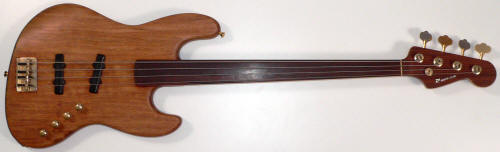
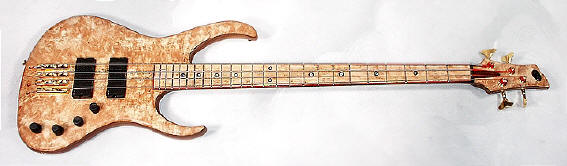
Ed's Personal Hand Built Neck Through Stretch Bass
Our most successful line of Basses has been the
Abstract brand.
Above the Stretch Bass & below the Scroll Bass
Abstract offers over 150 different bass shapes with many more to come.
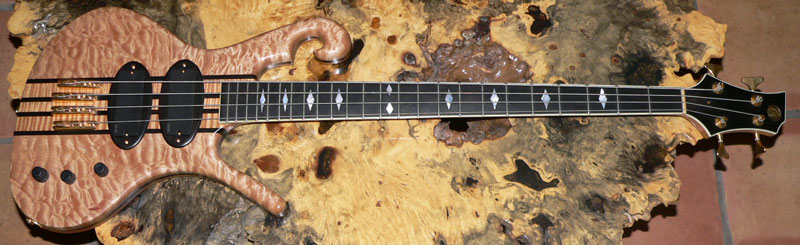
Ed experimented with various shapes & modernized double octave necks like above.